Blueprint
What is a blueprint
A blueprint represents a single core service or product that you sell. Here are examples of blueprints:
- Mowing
- Pruning
- Snow Plowing
- Patio
The idea is that you define a blueprint, with costs an materials for a certain size, and then leverage that blueprint across all your work.
Use Cases
Mowing
Lets say you offer Mowing as a service. In this case, Mowing will include the mowing and eding of the lawn, and blowing off hard surfaces. Those benefits come as a package deal. Lets also say, you can complete the service of 500 square feet (sq.f) within 20 minutes. There are no dump fees or materials in this blueprint.
This means, that you would estimte a 1,000sq.f property would take 40 minutes, and a 1,250sq.f property would take 50 minutes.
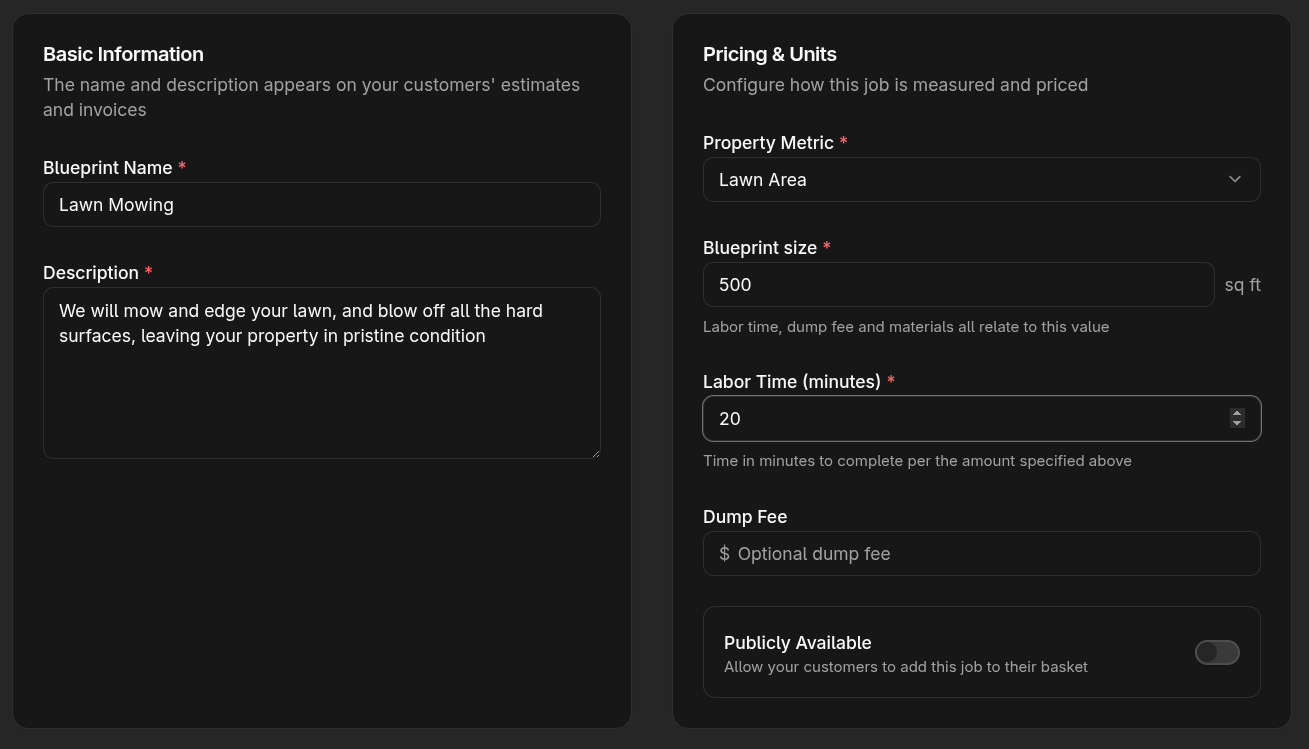
Note: The blueprint definition is the minimum size that you support. So a property of 400 square feet would be charged for 500 square feet. Larger properties will get a price proportial to the blueprint size.
Spring Cleanup
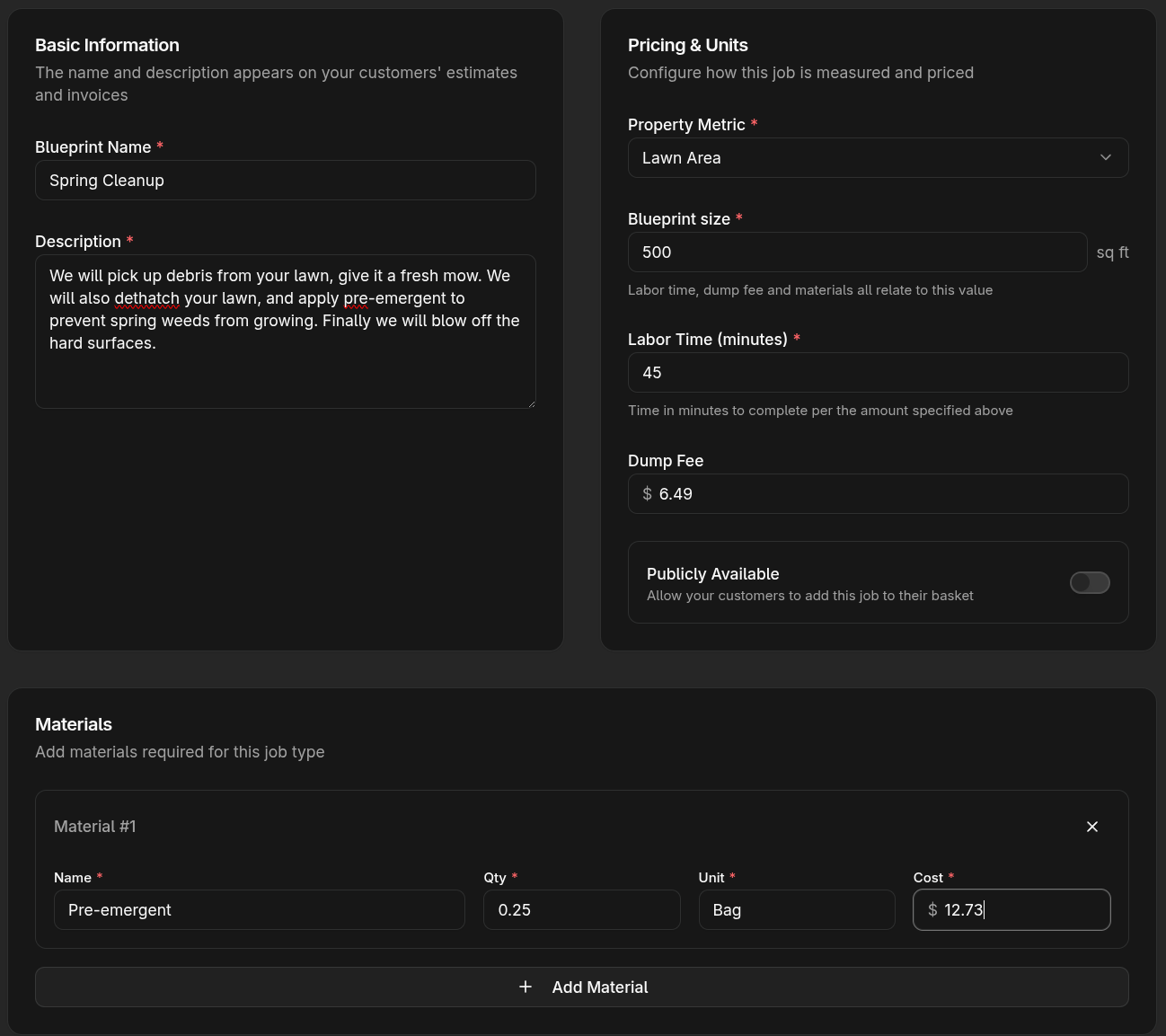
For spring cleanup, you might want to offer services that require materials and a dump fee. Here's a sample example
- Name: Spring Cleanup
- Description: Picking up debris from your lawn, dethatching and mowing your lawn, and finally, putting down an application of pre-emergent.
Tips on defining blueprints
A blueprint is defined based on a certain part of the customer's property and by labor hours. For example, trying to charge a 2 different prices for mowing time and dethatching time won't work. Blueprint are one-to-one to labor time.
Blueprints are also scoped to a property metric. You can't mix and match. For example, you wouldn't be able to have a blueprint for mowing and for pruning, because they apply to different parts of a property.
Lastly, blueprints cannot be split up. In the spring cleanup example, the whole service comes as a bundle. You could split up your blueprint into mowing/dethatching and applying pre-emergent, if you found that customers wanted to optionally add pre-emergent. In that case you should rather have 2 blueprints if you allow your customers to make that choice.
Efficiency through Blueprints
Once you define your blueprints correctly, your estimates should be quite accurate. It also allows you to utilize the pre-qualified estimates feature, where your customers can automatically get an estimate within seconds.
Adjustments for property quirks
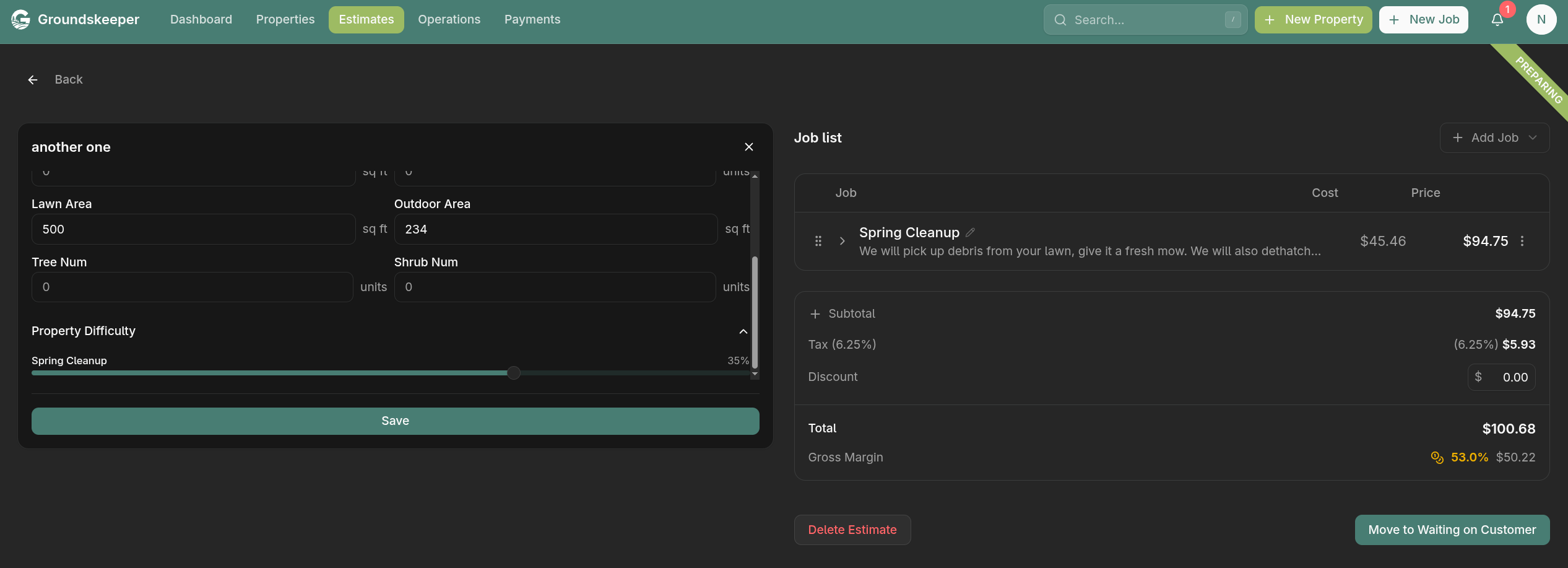
But, you say, some properties have the same size lawn, but can take longer to service. You're right! not all properties with the same dimensions take the same time to service. To account for that, you can adjust a property difficulty setting during estimation. This allows you to adjust the labor time for the specific property for that blueprint.
Time is money
You'll notice that there is no financial cost associated with a blueprint. You get to define your crew's hourly cost and charge-out rate independently of the blueprint. Since service time is essentially independent form the service cost, preparing a blueprint like this allows you to adjust your labor costs at will, without affecting any of your blueprints.